
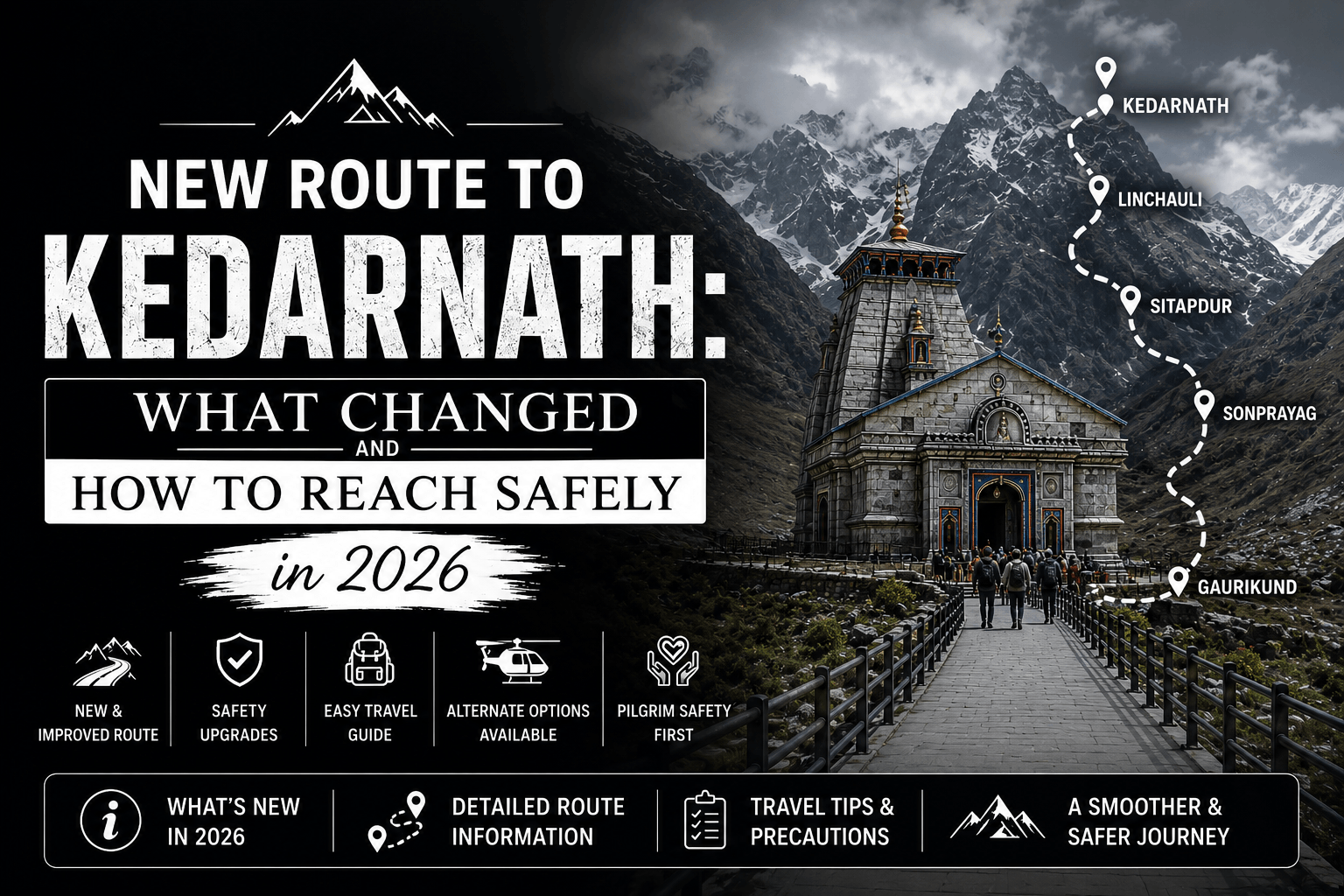
Pilgrims planning a Kedarnath visit often search for the “new route to Kedarnath” and for good reason. The path to the shrine changed permanently after the 2013 Uttarakhand floods, and understanding the current route helps you plan a safer, more realistic journey. This guide covers what changed, what the new trek looks like today, and why more pilgrims are now choosing to skip the trek altogether with a helicopter booking.
The Old Route to Kedarnath
Before 2013, pilgrims walked from Gaurikund to Kedarnath via Rambara, a stretch of about 14 km. It was a well-maintained path with proper pavements, railings, shops, and rest points along the way, considered one of the easier Himalayan pilgrim treks of its time.
Why the Route Changed
The devastating floods of June 2013 destroyed large sections of this original path, particularly around Rambara, which was almost entirely washed away. The old trek was damaged beyond repair, forcing authorities to construct an entirely new route to reconnect Gaurikund with the temple.
The New Kedarnath Trek Route Today
The current route, developed and maintained under the guidance of mountaineering experts, now runs through Linchauli instead of the old Rambara path. Only a rebuilt bridge marks where the original Rambara stop once stood.
Route breakdown (Gaurikund to Kedarnath):
Gaurikund → Rambara Bridge (6 km) → Jungle Chatti (4 km) → Bheembali (3 km) → Linchauli (4 km) → Kedarnath Base Camp (4 km) → Kedarnath Temple (1 km)
The total distance today is around 16–18 km, a few kilometers longer and noticeably steeper than the original route, something many pilgrims aren’t prepared for.
Facilities along the way include medical and first-aid points at Bheembali, Linchauli, and Kedarnath itself, along with tea stalls and resting sheds spaced through the trek.
Alternative trek routes also exist for those looking for a different path, though they’re far less used and have limited infrastructure:
- Chaumasi → Kham → Rambara → Kedarnath (~18 km)
- Trijuginarayan → Kedarnath (~15 km)
Why the New Route Is Tougher Than It Looks
Unlike the old pavement-style trail, the current path involves steeper climbs, longer stretches without shade, and unpredictable mountain weather, rain, sudden temperature drops, and thin air at higher altitude. For elderly pilgrims, young children, or anyone with health concerns, an 16-18 km trek each way (32+ km round trip) can be genuinely risky, not just tiring.
This is exactly why a growing number of pilgrims are choosing to fly instead of trek.
The Easier Alternative: Skip the Trek with a Helicopter
Instead of the multi-hour climb through Linchauli, a helicopter gets you from the base to Kedarnath in minutes, landing you close to the temple with no steep climbing involved. This is particularly valuable for:
- Senior citizens and anyone with mobility or health limitations
- Families travelling with young children
- Pilgrims short on time who still want a complete, unhurried darshan
- Anyone visiting during monsoon months when the trek becomes more hazardous
If you’re combining Kedarnath with the rest of the Char Dham circuit, Vaayu Aviation’s Char Dham Yatra by Helicopter package covers Yamunotri, Gangotri, Kedarnath, and Badrinath in about 5–6 days, all without a single kilometer of trekking.
If your focus is only on Kedarnath and Badrinath, the Do Dham Yatra by Helicopter package is built specifically for that shorter circuit, ideal if you have limited days but still want both darshans covered comfortably.
Ready to book your seat? Check current availability and pricing through our Char Dham Helicopter Booking page — it walks you through the full process, current prices, and everything included in the package.
Trekking vs Helicopter: Quick Comparison
| Factor | New Trek Route | Helicopter |
|---|---|---|
| Distance/Time | ~16-18 km, 5-8 hours one way | Minutes, aerial transfer |
| Physical strain | High — steep climbs, altitude | Minimal |
| Best suited for | Fit, young trekkers | Seniors, families, time-limited travellers |
| Weather risk | Higher exposure on foot | Weather-monitored flights, safer scheduling |
| Total time for full Kedarnath visit | 1-2 days minimum | Same-day possible |
Tips If You’re Still Planning to Trek
If you do choose the trek despite the difficulty, keep these in mind:
- Start early morning, night trekking is not permitted on the route
- Carry proper woolens and rain gear regardless of season; weather shifts fast at altitude
- Pony and palki services are available at various points if you get fatigued mid-way
- Basic medical facilities exist at Bheembali, Linchauli, and Kedarnath, but plan for contingencies if you have health conditions
- Book accommodation at Gaurikund, Sonprayag, or Linchauli in advance during peak season (May–June)
Frequently Asked Questions
Q1. What is the new route to Kedarnath?
The current trek runs from Gaurikund through Rambara Bridge, Jungle Chatti, Bheembali, and Linchauli before reaching Kedarnath a route developed after the original Rambara path was destroyed in the 2013 floods.
Q2. How long is the new Kedarnath trek route?
It’s approximately 16–18 km one way, slightly longer and steeper than the original 14 km route.
Q3. Is the new route safe for senior citizens?
It’s a demanding trek even for fit individuals. For senior citizens or anyone with health concerns, a helicopter transfer is a much safer and more comfortable option to reach Kedarnath.
Q4. Can I avoid trekking to Kedarnath completely?
Yes. Helicopter services fly directly to a helipad near the temple, eliminating the need to trek at all. This is the preferred option for most pilgrims travelling with elderly family members or on a tighter schedule.
Q5. How do I book a helicopter to Kedarnath as part of my Char Dham Yatra?
You can book through Vaayu Aviation’s Char Dham Helicopter Booking page, where you can check current pricing and confirm your travel dates.
Skip the steep climb – fly to Kedarnath instead. Explore Vaayu Aviation’s Char Dham Yatra by Helicopter and Do Dham Yatra by Helicopter packages, or head straight to Char Dham Helicopter Booking to check availability for 2026.
